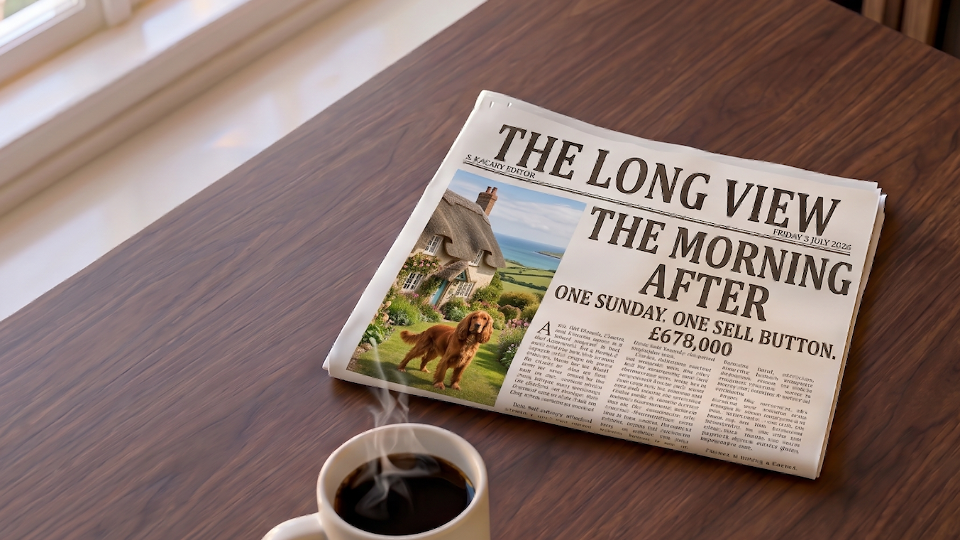
The Morning After
One Sunday evening. One Sell button. £678,000 in the balance.

The Story
Sarah is 46. It is Sunday evening. Her coffee has gone cold beside her on the kitchen table. Her laptop is open to Trading 212, and her cursor is hovering over the Sell button on the largest holding in her portfolio. She has been returning to this exact position for the past hour. Agitated. Unable to concentrate on anything else.
Sarah is not a trader. She is a fourteen-year steady holder of one broad global equity index fund plus a small UK component. Every month for fourteen years, since her daughter Emma was three, some of her salary has landed and remained there. She has weathered March 2020, the 2022 mini-budget, and three US election cycles by doing precisely nothing. Time in the market beats timing the market.
Emma is 17 now, applying to universities. Sarah has told her not to worry about the money. Every Sunday morning Sarah takes Benji, her chocolate cocker spaniel, down to the Broadstairs seafront for their walk. For three years they have walked past the same cottage with a sea view. She keeps thinking, one day. And there is a plan, somewhere between age 60 and 66, when Sarah has told herself she will slow down and go back to writing.
Last Wednesday she ran the Allocra ETF X-Ray. She had read Issue 1 of this newsletter and been curious. The X-Ray told her something she had not consciously known. Sixty-two percent of her portfolio was American. Fifteen percent of it was seven American companies. She had not chosen those seven companies. She had chosen passiveness, and that had chosen them.
That was Wednesday. By Sunday evening, three things had happened. A financial substack Sarah reads had published a piece titled "Why every long-term investor should be trimming tech now." A friend called Tom had texted saying he had gone to cash for a while, just until things settle. And the Reddit financial forums Sarah scrolls through on the train had spent the week relaying one message, over and over, in different combinations. De-risk. Trim. Rebalance. Simplify. An increasing gravity of opinion.
The information itself was not the problem. Sarah is not uninformed. The problem was that she was standing in the middle of it, holding one clean number from the X-Ray and a thousand random opinions from everywhere else. She did not know which of them to weight. That is what she was doing with her cursor over the Sell button. She was trying to weight the noise.
The X-Ray had told Sarah what her portfolio was made of. It had not told her what to do about it. Those are two different questions. What her portfolio is composed of is a matter of data. What she should do about it is a matter of her circumstances; her horizon, her income needs, university costs, the Broadstairs cottage and the years of contented writing ahead. The X-Ray doesn’t offer opinion, just the data, in a digestible format.
The mistake, if Sarah made it, would be to act based on a reflex. To let the growing noise question the concentration data shown on Wednesday, driving her to sell on Sunday. That is not a reasoned re-allocation. That’s a flinch: the reflex to sell, trim, or move to cash when nothing has actually happened except that the worry has grown louder.
Across long-run studies of investor returns compared to the returns of the funds those investors hold, the gap has been remarkably stable. Investor returns lag fund returns by around three percentage points a year, on average, over decades. Not because the funds underperformed. Because the investors flinched, at moments that looked something like Sarah on this Sunday evening. Attempting to time the market, rather than time in the market. Compounded over the twenty years from age 46 to Sarah's target retirement at 66, that three-percentage-point drag on £336,000 would be roughly £678,000 of forgone wealth.
A thousand small flinches. One Sunday, one Sell button, no crisis.
Not £678,000 in a spreadsheet. Emma's three years at Bristol and the masters she was already talking about. The cottage with a sea view in Broadstairs. The six years between age 60 and 66 when Sarah had planned to slow down and go back to writing. One clean number on the X-Ray from Wednesday. One weekend of noise. One Sunday evening, one cursor, one Sell button. Compounded across a working lifetime, a thousand versions of this Sunday.
The flinch reflex is not weakness. It is a protective instinct. It is trying to save Sarah from a threat. The threat it’s imagining is a physical one. But its heuristics are built for tigers rather than for markets. Running from a tiger works. Selling to cash on a Sunday evening when the market has done nothing dramatic and nothing specific has happened has an expected cost measured in Broadstairs cottages. The instinct is doing its job. The job does not translate.
Sarah moves the cursor away from the button. She closes the laptop. That’s a decision too.

Hype Watch · The De-risk Chorus
This week, across UK Reddit financial forums, the same conversation surfaced repeatedly across different communities. Investors with different ages and different portfolio sizes and different horizons were all reaching for versions of the same word.
The word that recurred was "de-risk." Also "trim," "simplify," "rebalance," "does it still make sense." Different phrasings, same underlying question. Should I sell some of what I have because I read something this week that made me nervous?
No individual asking the question is wrong. Every one of them may have a good reason for the specific action they are considering. What is worth noticing is that the collective conversation is warming up without a specific market crisis triggering it. There has been no crash this week. No policy shock. No headline event. Comparisons to previous market corrections, when the fundamentals do not support the comparison. The conversation is running on worry alone, nothing more. That is the flinch reflex at everyday temperature, before any of the fire alarms have gone off.
If some version of the conversation has crossed your kitchen table this week, you are not having it alone. That does not mean anyone is wrong to have it. It does mean that when the collective conversation is warming up on worry that has no specific trigger, the answer is not in the conversation. It is in what the diagnostic tools tell you. What you know about your own circumstances and what you know about your own horizon.

The Closer
The ETF X-Ray and the True Cost calculator are free, covering the nine most-held UK retail ETFs.
The Allocra beta opens Monday 20 July. Beta unlocks the calculators on your own holdings, and two of five separate tools at launch: the ETF Screener and the ETF Optimiser. The Dividend Tracker, the Rebalancer, and the Tax Optimiser follow after the beta period.
No tool will ever tell you what to do.
That part is yours.
Run the X-Ray →Forward this issue to one independent investor friend who might be hovering over a Sell button this weekend.
The Long View is general educational content for UK and US independent investors. It is not investment, tax, financial, or any other form of regulated advice. Allocra Ltd is not authorised or regulated by the Financial Conduct Authority. Past performance is not a guide to future returns.
Issue 3 of The Long View. Published 3 July 2026. Previous: Issue 2, The Ferrari was Free. Forward this issue to one independent investor friend.
allocra
Cut the noise. Cut the fees.