The Man Who ‘Failed’, By Being Right
He predicted the AI boom in writing, raised a fund on his own conclusion, and was up 439 per cent by the end of June. By August he had been forced to sell everything. Both things are true, and the gap between them is this week’s lesson.

The Story
Two years ago, a young researcher, Leopold Aschenbrenner, published an essay about the future of artificial intelligence. He was in his early twenties, recently departed from OpenAI, and the essay predicted that machine intelligence would arrive faster than institutions could imagine. The constraint wouldn’t be ideas, it would be infrastructure. Chips. Memory. Datacentres. Power.
He raised a hedge fund and named it after the essay, Situational Awareness. Then he bet the fund on his own conclusion: if intelligence was about to scale, own the things it scales on.
And here is the part of the story you need to hold onto, because everything that follows depends on it: he was right.
By the end of June this year, Situational Awareness was up 439 per cent for the half year, net of fees. Not a typo. Assets touched 45 billion dollars. The memory makers, the datacentre operators, the compute landlords, all the unglamorous plumbing of intelligence he had named in the essay, had become the best trade in the world. He had called it in public, in writing, before it happened. By June, he was arguably the most right investor of the year.
The Mechanism
The fund did not just own the trade. It borrowed to own more of it. Reported leverage ran as high as 400 per cent: roughly four dollars of exposure for every dollar of capital.
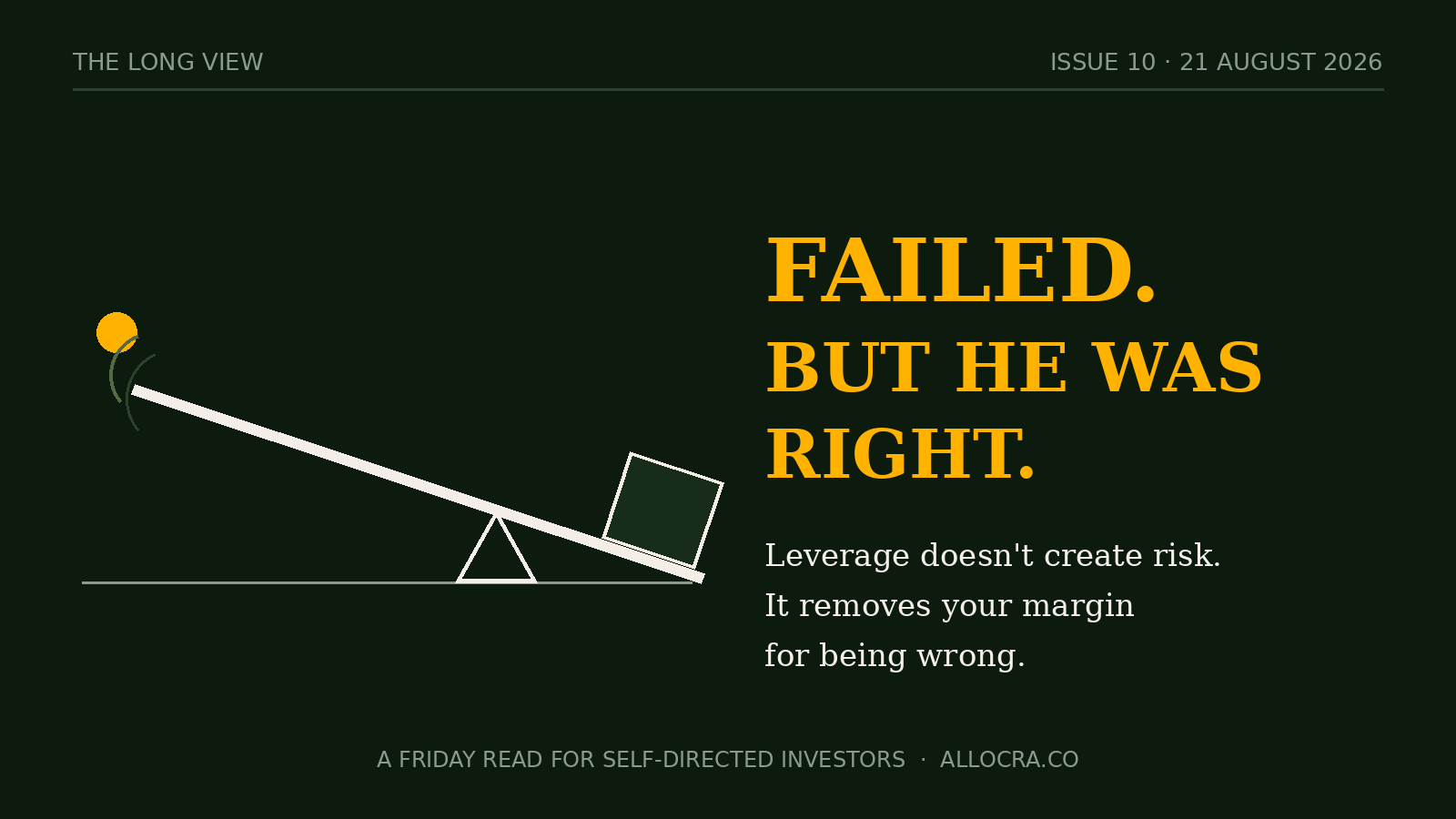
Leverage doesn’t create risk. It removes your margin for being wrong.
At one times your money, a bad month is a bad month. You hold, you wait, you find out later whether you were early or wrong. At four times, a bad month is a phone call. The waiting is no longer yours to decide. Somebody lent you the exposure, and they, not you, own the timetable.
In July, prices moved against him. Not the thesis. The prices. The same memory chips and datacentres, the same names, fell hard, some of his largest disclosed positions losing more than 35 per cent inside the month. On four times leverage, falls like that do not reduce a fund. They dismantle it.
And then something stranger happened, something worth slowing down for. As the fund was forced to sell, its own selling became the market. These were concentrated positions in a handful of names, and for weeks those stocks fell on days when the companies reported strong earnings. Read that again: good news, falling prices. The prices were not carrying information any more. They were carrying one margin account.

The Experiment Reports
In the last days of July, it ended the way these things end. The fund sold its entire public portfolio in a negotiated transaction, reported to be with Citadel, to settle what it owed its lenders. Forty-five billion dollars of assets at the start of the month; roughly ten billion after. The most right investor of the year sold everything, at the bottom, on someone else’s schedule.
Then the market delivered its verdict, faster than anyone expected.
Within days, the same stocks surged. One of his largest positions rose 21.8 per cent in a single session. Analysts called his liquidation the clearing event: the selling pressure that had been holding the whole sector down was his, and when it cleared, the prices went back to carrying information. The information was the same as it had been all along. The earnings were strong. The demand was real. The thesis was intact.
The recovery began the day his selling stopped. He was no longer in it.
Two honest things must be said here, because this is not a story about a villain and not a story of ruin. His investors were institutions who knew the terms; the leverage was no secret to the people whose money it was. And he was not destroyed: the fund’s private stakes survived the fire sale, within a week he was reported to be investing again, and investors were reportedly asking to place more money with him, not less. He will be back. He may even be right again.
The workings: where the numbers come from
439% first-half net return and the 45-billion-dollar peak: reported by CNBC and Disruption Banking, 30 to 31 July 2026. Leverage of up to 400% and the largest disclosed positions (Nebius, Sandisk, Micron, CoreWeave, SK Hynix) each falling more than 35% in July: CNBC, 30 July. Full public unwind in a negotiated transaction reported to be with Citadel, lenders settled, assets roughly 10 billion after: CNBC, 31 July. Private stakes preserved: TechCrunch, 30 July. Return to investing with a 400-million-dollar private commitment, and investor demand thereafter: Bloomberg, 5 and 7 August. CoreWeave up 21.8% in a single session as the unwind cleared: Seeking Alpha; clearing-event framing: CNBC and Investing.com, 8 August. The world-index observation below: Micron sits in the published top-ten holdings of MSCI World tracker funds in issuer files dated 14 to 18 August 2026, held in Allocra’s composition feed, which refreshes weekly. Every claim dated; where we cannot verify, we show a dash rather than a guess.

The Index Never Noticed
Here is the part worth highlighting. One of the stocks at the centre of this story sits, today, in the top ten holdings of the plainest instrument in investing: a world index fund. It sat there before July. It sat there through July. It sits there now, having ridden the fall and most of the recovery, and at no point did anyone holding that index receive a phone call from a lender.
The index was not smarter than him. It knew nothing. It had no thesis, no essay, no leverage and no timetable. It simply owned a small piece of everything, borrowed against none of it, and was therefore allowed to be wrong for as long as being wrong lasted. That is the entire trick. Diversification is not a bet against brilliance. It is the admission that even when you know WHAT will happen, you do not know WHEN, and the gap between those two is where leveraged fortunes go to die.
Last week, this letter was about a chart that never moved. This week, a man who moved too much. It is the same lesson approached from opposite ends: the market pays for patience more reliably than it pays for conviction, and it never pays for conviction on a deadline. If you want to see how much of your own money rides a fund’s largest names, our ETF X-Ray reads the issuer’s own published holdings and shows you, workings included.
He was the most right investor of the year. In July, it did not matter.
Got a Hype Watch suggestion? Send it to hype@allocra.co