The August Illusion
The Premier League is back, and right on cue a newly promoted club has beaten a giant. This week’s letter is about why the August table lies, in football and in fund flows, and what wins over the full season.

The Story
On Saturday afternoon at the MKM Stadium, newly promoted Hull City beat Manchester United 2-0. A header from a corner, another header before half time, and one of the wealthiest clubs in world football spent the rest of the game passing sideways in front of a wall of amber shirts. Hull are back in the top flight after a decade away. Fans allowed themselves the oldest August dream: maybe this season life in the top flight will be different.
Here is what makes Saturday interesting to this letter: we have seen this exact film before, starring this exact club.
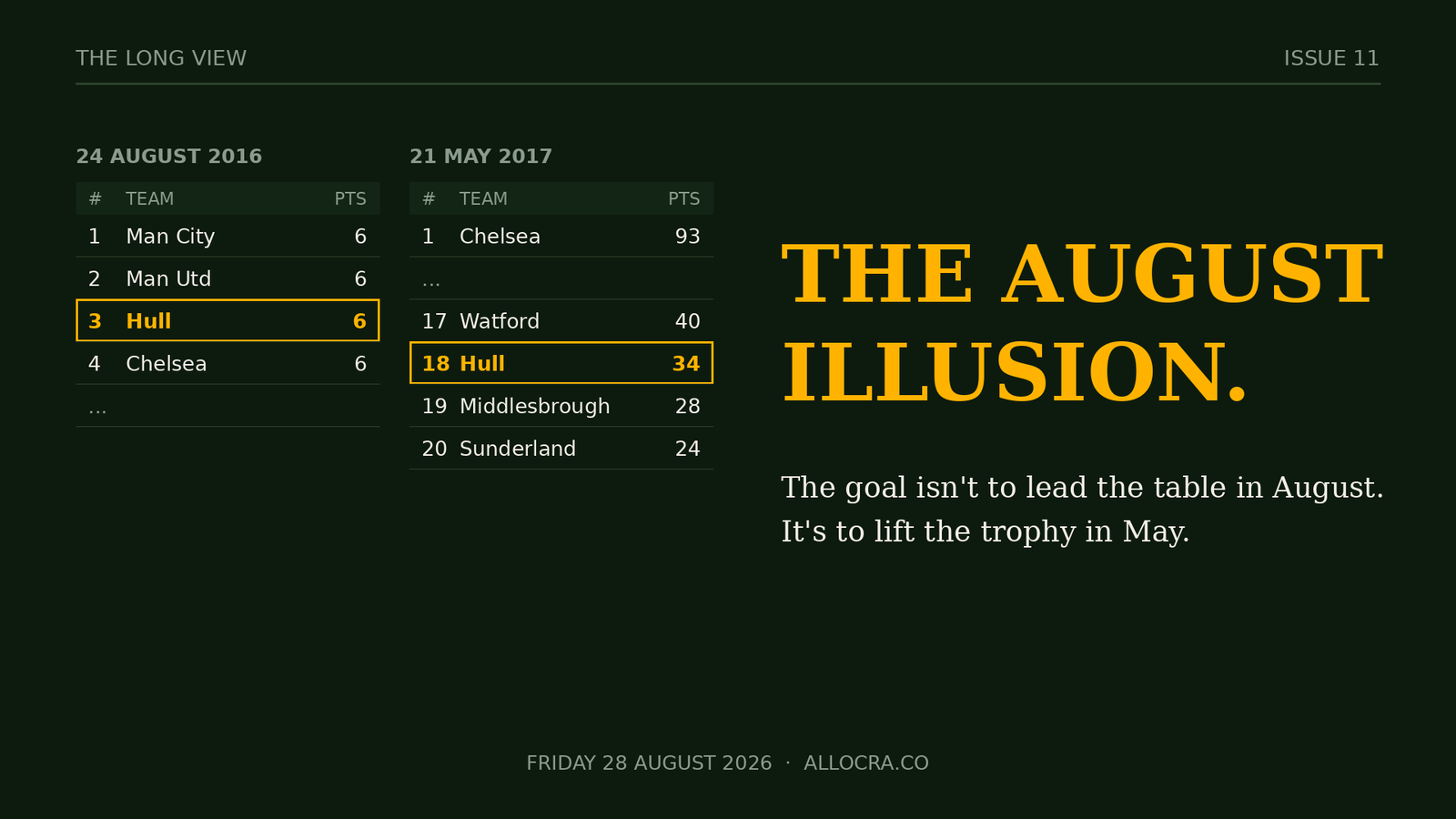
On the opening day of the 2016 season, newly promoted Hull City beat the reigning champions. Leicester, the miracle winners of the year before, went down 2-1 at the same ground. Hull had the thinnest squad in the division and didn’t even have a permanent manager; a caretaker picked the team. They won their opening two games. The league named that caretaker its Manager of the Month for August. It was, by any measure of form, the best small club start in years.
By May, Hull City were eighteenth and relegated.
The August table was not wrong about what happened. It was wrong about what it meant.
The Mechanism
August lies for a reason, and the reason is arithmetic, not romance. Two games is the smallest sample the season ever offers. Opponents are mid-rebuild, coaching frameworks are fresh, and new teammates are just getting acquainted. A deflected goal carries a week of narrative. Luck has its loudest voice in small samples, and August is nothing but small samples.
Then the winter schedule arrives. Games come every few days. Injuries stack. The fixture computer stops being kind. What gets a squad through December is not euphoria; it is depth, the ability to rotate players without impacting the team performance. Over thirty-eight games, depth beats desire almost every time, because consistency is precisely the thing that separates the two.
Form is a small sample. Class is a full season.
Markets run the same experiment with money. Every few years a fund catches its August: a concentrated bet on the loudest theme of the moment, and for a stretch the returns are enormous. This is the part people misread. The trap is not fake numbers. The numbers are real, audited, and delivered over short distances, exactly like Hull’s six points. The illusion is in the meaning: a lucky run of fixtures mistaken for a structural advantage. The streak recruits believers, the believers arrive with money, and the money arrives after the performance it is chasing.

The Experiment Reports
The cleanest modern case is the flagship innovation fund of the last cycle. In 2020 the ARK Innovation ETF returned 152.8 per cent in a single year. Real returns, real audits, the best-performing story in the market. The money arrived next: assets peaked in 2021, AFTER the extraordinary year, at roughly seventeen billion dollars. Then the environment turned. The fund lost 23.4 per cent in 2021 and 67.0 per cent in 2022. The fund’s history books record the 152. Most of the actual dollars in the fund experienced the minus 67, because most of the dollars arrived between the two.
This is not one fund’s quirk; it is measurable across the whole industry. Morningstar’s Mind the Gap study, the 2025 edition, compares what funds returned with what their investors actually earned, weighted by when the money showed up. Over the ten years to the end of 2024, funds returned 8.2 per cent a year; their investors earned 7.0. The missing 1.2 points a year, roughly 15 per cent of the total return, is the cost of timing: buying after the good stretch, selling after the bad one. The gap has been stable across every ten-year window Morningstar has measured. It is the August illusion, industrialised.
And Hull? The season that began with champions beaten and a Manager of the Month award ended with 34 points. The illusion did not survive contact with the fixture list. It never does.
The workings: where the numbers come from
Hull City 2-0 Manchester United, MKM Stadium, 22 August 2026: ESPN, Sky Sports and Al Jazeera match reports. Hull City 2-1 Leicester City on the opening day, 13 August 2016, under caretaker Mike Phelan: NBC Sports and BBC Sport; Phelan named Premier League Manager of the Month for August 2016: BBC Sport. Hull’s final 2016/17 position, eighteenth with 34 points (won 9, drew 7, lost 22): the final Premier League table, cross-checked against FBref and Bleacher Report. The two table snapshots on the plate are dated 24 August 2016 and 21 May 2017. ARK Innovation ETF calendar returns, plus 152.8 per cent in 2020, minus 23.4 in 2021, minus 67.0 in 2022: fund performance records via Morningstar and Yahoo Finance; average monthly net assets peaking at roughly 17.3 billion dollars in 2021: ARK ETF Trust SEC filings. The investor return gap: Morningstar, Mind the Gap, 2025 edition, funds 8.2 per cent a year against investors’ 7.0 dollar-weighted over the ten years to 31 December 2024, a 1.2 point annual gap, roughly 15 per cent of the total return. Every claim dated; where we cannot verify, we show a dash rather than a guess.

The Deep Bench
Now consider the most uninspiring squad in investing: the broad, diversified portfolio. A global index book has never topped August’s table. It never trends, never produces a viral streak, and its month of glory literally cannot happen, because it owns the heroes and the fallen alike, in small, unglamorous weights.
It also has never been relegated. No single injury can end its season, because no single player IS its season. It grinds out points through every winter the market has yet produced, and compounding is a thirty-eight game trophy, not an opening-day headline. Depth is the football word for diversification. The full fixture list is the football word for a market cycle. The clubs that lift trophies in May are almost never the ones that led the table in August, and the portfolios that fund retirements are almost never the ones that led your feed in any given year.
Hull may stay up this time; we hope they do, and the point does not depend on them. The point is older than any one season. Euphoria is loud, class is quiet, and the difference between them only shows up with repetition.
Last week, this letter was about the most right investor of the year, undone by a timetable. This week, the oldest trick in the season: form mistaken for class. It is the same lesson wearing different colours. If you want to see how much of your own book rides this year’s August heroes, our ETF X-Ray reads the issuer’s own published holdings and shows you, workings included.
Don’t build a financial future on opening-day form. The goal isn’t to lead the table in August. It’s to lift the trophy in May.
Got a Hype Watch suggestion? Send it to hype@allocra.co