The Perfect Crime
No alarm sounds. Nothing is ever reported missing. This week’s letter is about money that leaves a portfolio slowly, legally, and with the owner’s approval, by signature, and about why the paper trail was completed before anything began.

The Scene
Picture the scene of the crime, if you can find it. It’s taking place on every street, in every town and city across the UK.
There’s no broken window. The statement arrives on time and the balance is higher than last year. The owner checks it, feels reasonable satisfaction, and files it away. Nothing has been taken that ever arrived.
That is the difficulty with this case. The loss is not a line on the statement. It is the difference between the statement you received and the one you could have received, and that second statement doesn’t exist anywhere. Nobody mourns something they never had. Most victims go their whole lives without learning they were involved.
The Method
The method is arithmetic, applied patiently.
Take £250,000, invested for 25 years, growing at 5% a year before costs. Left to compound untouched, it reaches roughly £846,600. Now introduce total annual costs of 1.5%, which is not a caricature: layered platform fees, fund charges, transaction costs and assorted frictions have put many ordinary portfolios in that territory. The same money, the same markets, the same 25 years now deliver roughly £590,800.
The difference is a little over £255,000. More was removed than the £250,000 originally invested.
In year one this feels like nothing, because it is nearly nothing: about £312 a month on that balance, collected smoothly, never as a single visible event. The removal is sized precisely to the victim’s threshold of attention. And the true damage is not the £312. It’s that every £312 taken early forfeits its own quarter century of growth. The method does not steal money so much as it steals the money’s future.
For contrast, run the same portfolio at total costs of 0.3%, which careful independent investors routinely achieve. It finishes at roughly £788,100. The gap between the careful path and the expensive one is just under £198,000, on identical investments. These figures are illustrations of arithmetic, not predictions; the percentages are the point, and they scale to any sum.

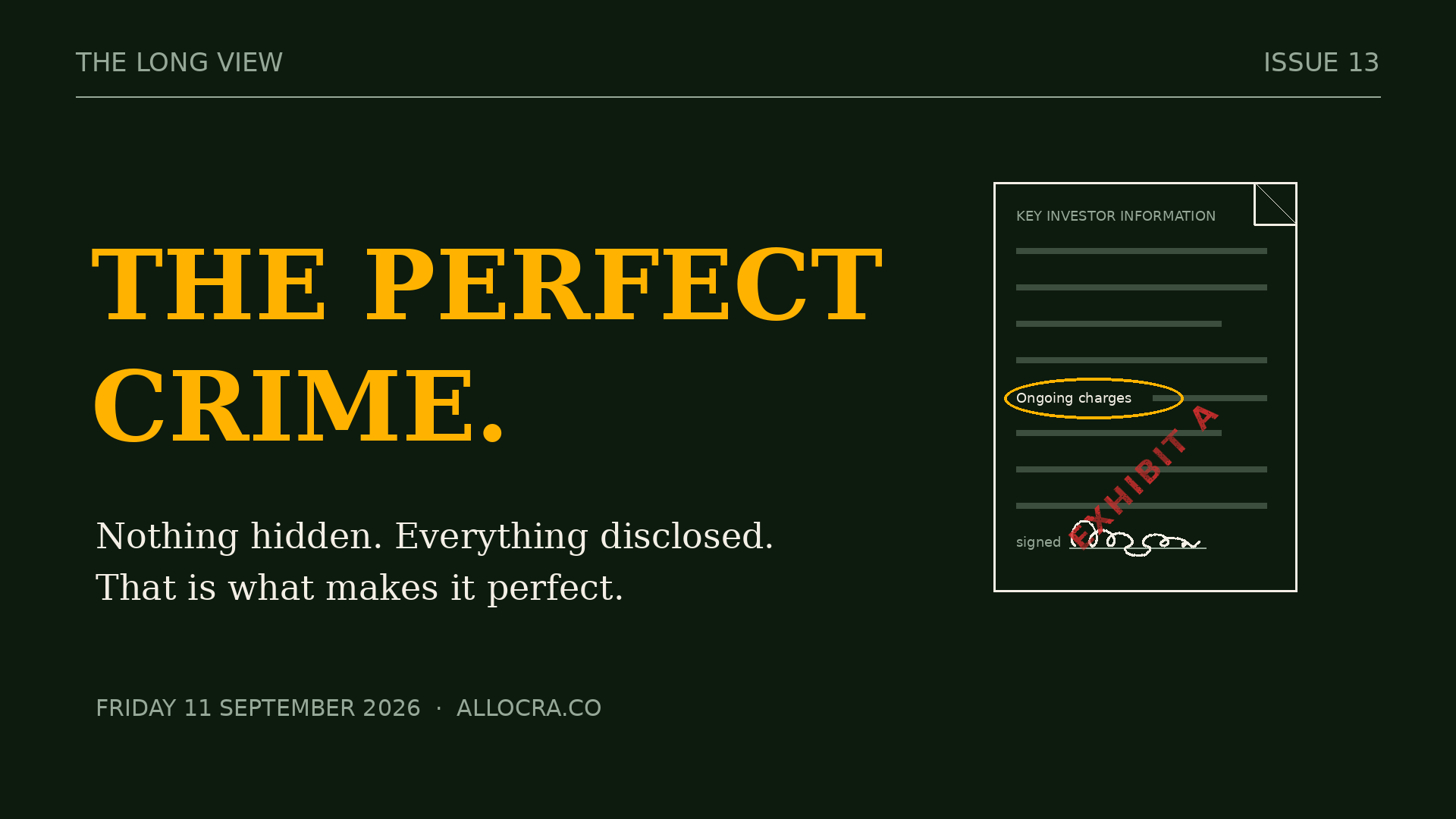
Exhibit A: The Confession
Here is what separates this from ordinary theft, and it is the detail the whole case turns on: every element was disclosed in advance.
The fund’s ongoing charge is printed in a regulated document that was available before purchase. The platform’s fee schedule is published on its website. The foreign exchange margin, the dealing charge, the charge for reinvesting your own dividends: each one is in the terms and conditions, in language that is dense but not dishonest. The customer ticked a box confirming they had read them.
A prosecutor would find, in effect, a signed confession filed by the perpetrator before the event, and a consent form signed by the victim. Except those words are wrong, and this letter should not pretend otherwise. There is no perpetrator, and legally there is no victim. There is a lawful service, priced as its provider chooses, purchased by a customer who agreed. The documents prove it.
That is what makes it perfect. Not that the evidence was hidden. That the evidence makes it legal.
Why Nobody Calls It In
No conspiracy is required for any of this, and it would be a worse letter if it pretended one existed. Nobody meets in a basement to plan your fees. An industry simply evolved pricing structures that are individually defensible, collectively expensive, and perfectly aligned with how human attention works: percentages rather than pounds, monthly rather than annually, deducted rather than invoiced.
And the people who pay are not fools. They are busy. They are teachers and engineers and nurses who have been told, correctly, that investing is important, and who then did the responsible thing by handing the details to professionals or to a platform chosen years ago for reasons nobody remembers. The system asks them to notice a number that is designed to be unnoticeable, compounding in a direction they never see. Missing it is not stupidity. It is the expected outcome.
Which is why there is no scandal here to report, no enforcement action to await. Regulators require disclosure, and disclosure was made. The case is closed before it opens, every time.
The workings: where the numbers come from
The worked example is pure arithmetic on stated assumptions: £250,000 compounding for 25 years at 5% a year before costs reaches £250,000 × 1.05²⁵ ≈ £846,600. Costs are applied by reducing the annual rate: at 1.5% total costs the portfolio compounds at 3.5% to ≈ £590,800; at 0.3% it compounds at 4.7% to ≈ £788,100. The removal under the 1.5% path is £846,600 − £590,800 ≈ £255,800, which exceeds the original £250,000; the gap between the two cost paths is ≈ £197,300. Year-one cost at 1.5% on £250,000 is £3,750, or about £312 a month. These are illustrations of the arithmetic convention published in our methodology (drag compounds multiplicatively; it is not subtracted at the end), not predictions of any market or product. The cost study: Russel Kinnel, How Expense Ratios and Star Ratings Predict Success, Morningstar, August 2010: expense ratios beat star ratings as a predictor in every asset class and every period tested.

The Investigation
The one consolation is that this is the rare corner of investing where the investigation is easy, because costs are the rare number disclosed before the fact.
Nobody will tell you next year’s returns. Nothing in a fund document predicts what markets will do. But the charge is printed now, today, in advance, and it is contractually what you will pay. In 2010, Morningstar’s Russel Kinnel published a study comparing how well expense ratios and the firm’s own star ratings predicted future fund performance. Expenses won: in every asset class and every period tested, low costs were the more reliable signal. The most useful predictive number in the entire industry sits in plain sight, on a page most people have never turned to.
So the detective work amounts to this: find the ongoing charges figure for each fund you own. Find your platform’s fee page and work out what you paid last year in pounds, not percentages. Add them. If the total surprises you, the investigation has already paid for itself, and unlike almost everything else in investing, fixing it requires no forecast, no timing and no luck.
The perfect crime is the one you agreed to in the terms and conditions. The perfect defence is reading them.