Basis Points
Rates are staying put, a fund that pays you every week, and £114 of income you never received. What moved this week and what to do about it.
From today The Long View is more concise: what moved this week and what it means for you, with a question at the end. The essays continue, only shorter, because a good story is still the best way to remember a point.

This week
Rates are not coming down this autumn. The Bank of England held at 3.75% and three of the nine committee members wanted a rise. Inflation is 3.1% and heading up. What it means for you: a savings account paying 4% is making you roughly 1% a year after inflation, and a fund yielding 4% is doing the same. Look at every return after inflation, never before.
You may soon get help choosing investments from your bank or platform. Nine firms are now allowed to give “targeted support”, a new halfway house between no advice and full advice, free at the point of use. What it means for you: useful, but remember who’s paying for it. A suggestion from a firm that sells the product is not the same as advice you pay for. The same speech admitted that only 6 in every 100 fund documents are written in plain English. If you can’t understand what you’re buying, that’s the document’s fault, not yours.
A fund that pays you every week has arrived. Europe’s first weekly-paying ETF listed in London on 16 September. Note that it earns the payment by selling away some of your upside, and the small print allows it to pay you out of your own capital when it needs to. What it means for you: how often a fund pays says nothing about how much it earns. Weekly income can be your own money coming back at the expense of future growth.
HMRC’s list has not caught up with the new launches. The list that decides whether a fund’s gain is taxed at 24% or at up to 45% is dated 4 September, and the next one is due in early October. What it means for you: if you hold any fund outside an ISA or pension that launched this summer, check it against the October list before you assume it’s fine.

One number
£114. If you held 100 units of the most popular global tracker in a normal dealing account last summer, that’s roughly the income HMRC says you received on 31 December, even though not a penny arrived. Accumulating funds keep the dividends and buy more units with them; the tax is still yours to declare. Most people haven’t heard of this, and most platforms don’t put it on your tax certificate.
What to do: if you hold accumulating funds outside an ISA or pension, ask your platform whether your annual statement includes “excess reportable income”. If the answer is no, you have some spreadsheet calculations for January.
The question
CSPX and CSP1 are two tickers on the London Stock Exchange for exactly the same fund. What’s the only difference between them, and which one costs you money to buy? The explanation is in next week’s issue.
The long read: The checker-shadow illusion
In 1995 an MIT vision scientist, Edward Adelson, published a picture that proves your brain lies to you. A checkerboard, a cylinder, a shadow. Square A, out in the light, looks dark grey. Square B, inside the shadow, looks light grey. They are the same grey.
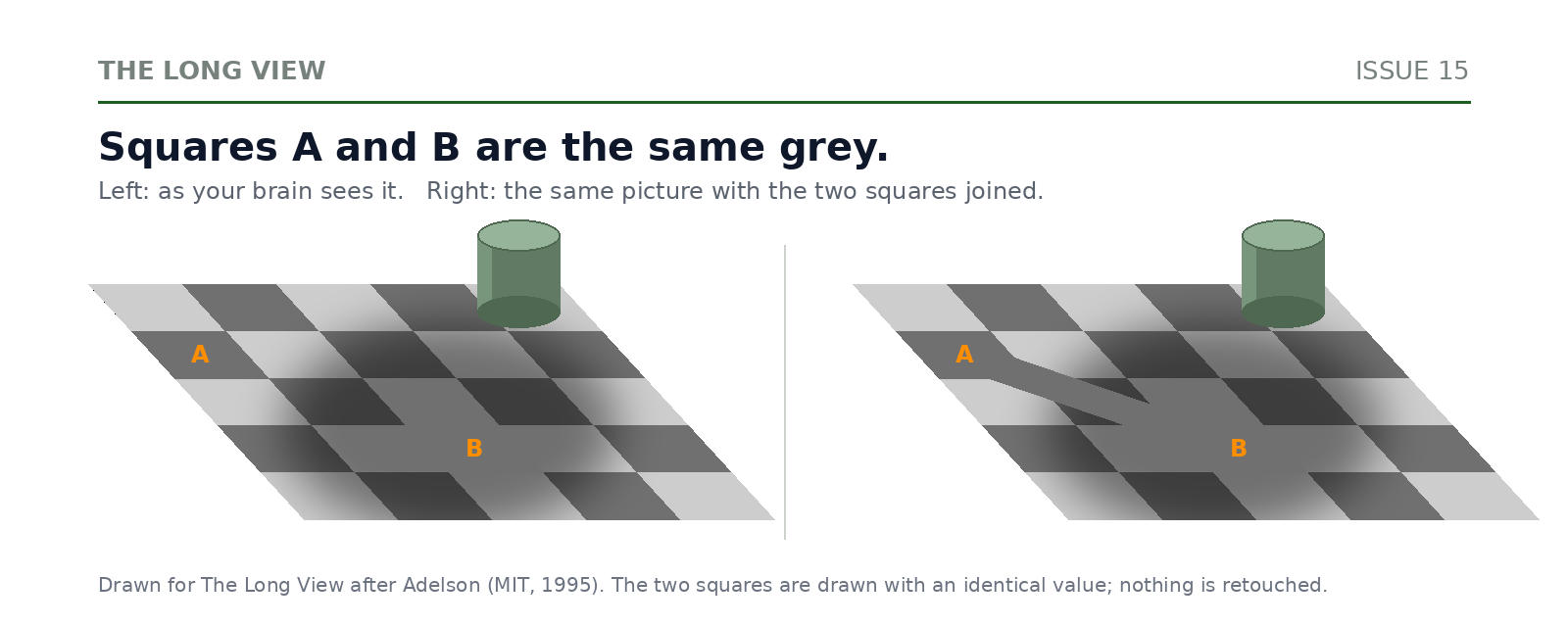
Look at the drawing above, then at the one beside it. People do not believe it until they cover the rest of the picture with their hands. Your brain sees the shadow, decides that anything still reflecting that much light from inside it must be pale, and paints square B lighter for you. Context overrides the data, and you never feel it happen.
Investments sit in shadows too. A leveraged fund in the spotlight of a hype cycle looks safer than it is. A plain global tracker in the shade of boring old finance looks duller than it is. When everyone is talking about a sector, your sense of its risk drops, not because the risk changed but because the lighting did.
Next time something looks obviously bright, cover the rest of the picture. Look at the fund on its own: what it holds, how concentrated it is, what it costs. Then judge the grey.

Diary
- 28 October 2026: the Budget.
- 6 April 2027: unused pensions come inside inheritance tax; savings income tax rates rise by two points; a £12,000 cash ISA limit for under-65s.
- 8 June 2027: new fund disclosure rules become mandatory.
- 6 April 2028: the earliest age to draw a pension rises to 57.
- 6 April 2029: salary sacrifice above £2,000 starts to attract national insurance.
- 5 April 2031: the inheritance tax threshold freeze ends.
Reply with your answer, or with anything you spotted this week that should have been here.
Sources
Sources: Bank of England, Monetary Policy Summary, meeting ending 16 September 2026, published 17 September; Office for National Statistics, CPI August 2026 as cited by the Bank. FCA, Building a stronger UK investment culture, speech of 18 September 2026 (nine firms authorised for targeted support; 6% of pre-sale disclosure documents in plain English by the Flesch-Kincaid test). HANetf and Aura ETFs, launch of Weekly World Income UCITS ETF, ticker WEEK, ISIN IE000I50V6C7, ongoing charge 0.50%, 16 September 2026; the prospectus risk factors state dividends may be paid from capital. HMRC, Approved offshore reporting funds, list file dated 4 September 2026, page updated 9 September 2026; updates over the past year fell between the 3rd and the 14th of each month. The number: iShares III plc, report to investors for the year to 30 June 2025, iShares Core MSCI World UCITS ETF USD (Acc), ISIN IE00B4L5Y983, excess reportable income USD 1.534233 per unit, fund distribution date 31 December 2025; Bank of England spot rate 31 December 2025, USD 1.3451 per pound; 100 units is £114.06. Adelson, E. H., Checkershadow Illusion, MIT, 1995; the drawing here is our own, with squares A and B drawn at the identical grey value (112 of 255) and checked pixel by pixel at build. Diary: Finance Act 2026; HM Treasury, cash ISA announcement 23 June 2026, updated 14 August 2026, regulations not yet made; FCA PS25/20; HM Treasury, Chancellor's letter to the Treasury Select Committee, 31 July 2026: Budget on Wednesday 28 October 2026. No product is mentioned in this issue and nothing here is a recommendation.