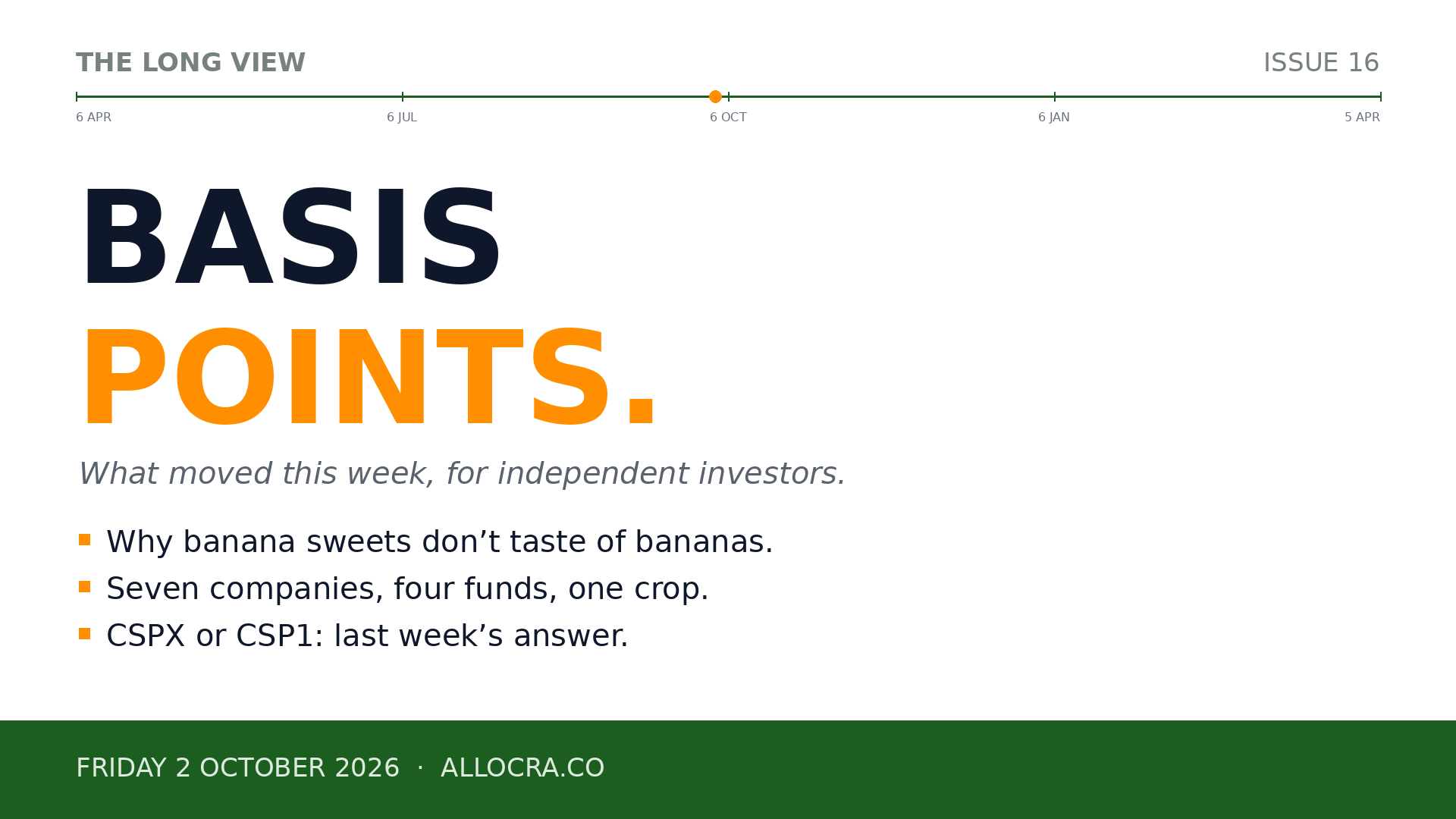
Basis Points
A banana that no longer exists, the seven companies in every tracker you own, and the answer to last week’s question.

This week
Crypto firms can now apply to be regulated. From Wednesday 30 September, firms offering crypto in the UK can apply to the FCA for authorisation; they must apply by 28 February 2027 and the regime takes effect on 25 October 2027. What it means for you: nothing changes about what crypto is, only about who may sell it to you and what protections apply. Until October next year, the firm you use may still be outside the regime entirely.
Twenty-four CFD firms are closing after a regulator crackdown. The FCA says the firms used a UK authorisation as a badge to make overseas sister companies look safer than they were. What it means for you: the register tells you which company you are actually dealing with, and a similar name is not the same firm. Check the exact legal name on the FCA register before money moves.
Four weeks to the Budget. Wednesday 28 October. The announced changes already in the diary below are law or stated policy; anything else you read before the day is speculation. What it means for you: the allowances for this tax year are what they are today, and decisions made on rumours tend to be the expensive ones.

One number
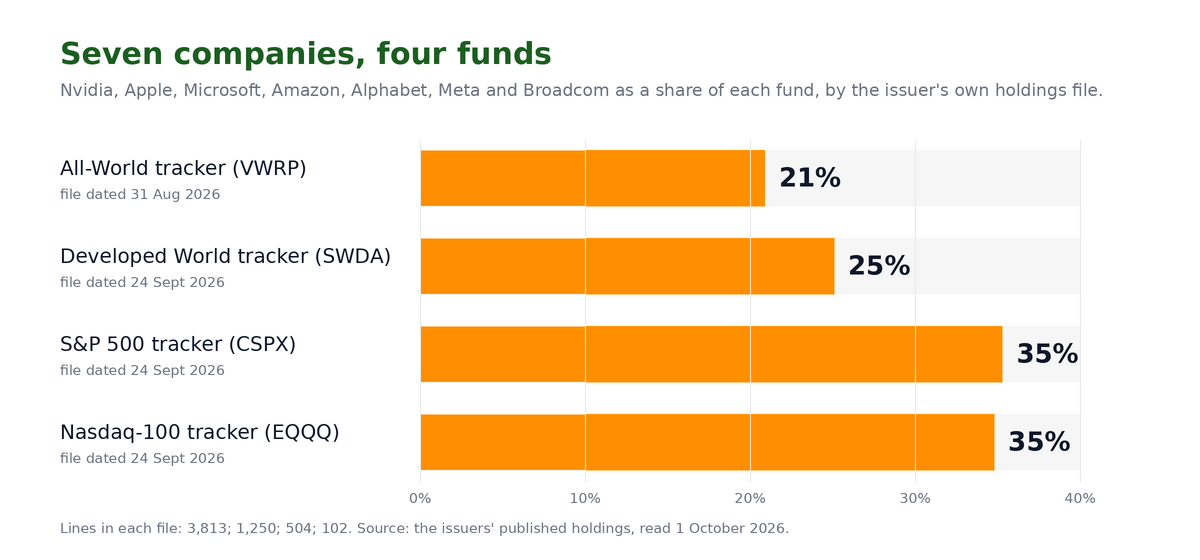
Seven. Nvidia, Apple, Microsoft, Amazon, Alphabet, Meta and Broadcom. Those seven companies are 21% of the most-bought all-world tracker, 25% of the most-bought developed-world tracker, 35% of the most-bought S&P 500 tracker and 35% of the most-bought Nasdaq-100 tracker, by the issuers’ own holdings files dated between 31 August and 24 September 2026. So what: an investor holding all four of those funds doesn’t own four things. They own the same seven companies four times over, with a different label on each tin. The long read below is about what happens to a crop like that.
The question
Last week’s answer. CSPX and CSP1 are the same fund, the same share class and the same ISIN, IE00B5BMR087. The only difference is the currency the London price is quoted in: CSPX in dollars, CSP1 in pence. Your money buys the same units either way. What differs is the toll on the way in. Most platforms treat the dollar line as a foreign-currency deal and apply their currency charge: 0.99% on the first £10,000 of a trade at one large platform, 0.15% at another, on rate cards checked 1 October 2026. Buy the sterling line of a fund that has one, and the charge never arises.
This week’s question. A fund’s factsheet says it holds 1,250 companies. Another says 504. Both put Nvidia at the top. Which of the two is more concentrated in its top ten, and by how much? Reply with your answer; the figures, from the issuers’ own files, are in next week’s issue.
The long read: Why don’t banana sweets taste of bananas?
Try a foam banana. They inexplicably live side-by-side with foam shrimps. It tastes of something, but not a banana. In the UK, it resembles a pear drop, as both are the same chemical, isoamyl acetate. Chemists sold it as “fruit essence” from the 1850s, a decade before most people had tasted a banana.
Whilst the British thought it tasted like a pear, Americans likened it to the banana they had just tasted. This was unlike any banana we have now, it was the Gros Michel; the Big Mike. Thick skinned, slow to ripen, easy to ship green and sell yellow, and richer in that one chemical than anything we eat today. For the first half of the twentieth century it was the only banana that mattered. Every plantation grew it, and every plant was a cutting of the same plant: one variety, no seeds, no variation, from Honduras to Jamaica.
That was the design flaw. A soil fungus, Panama disease, arrived in the 1950s, and because every plant was the same plant, every plant was equally defenceless. By the 1960s the Gros Michel could no longer be grown at scale anywhere. The industry replanted with the Cavendish: blander, less fragrant, but resistant to the fungus. That is the banana sold today. The sweet kept the old recipe, because a bland foam banana wouldn’t be as popular.
What’s surprising is that the Cavendish is grown exactly the same way. One variety, every plant a clone. A new strain of the same fungus, Tropical Race 4, that the Cavendish cannot resist, initially worked its way through Taiwan, China, Indonesia and Malaysia. It reached Colombia in August 2019, Peru in April 2021 and Venezuela in 2023. History is a great teacher, but the industry ignored the lesson and repeated the same choice. A single clone is cheaper to grow, ship and sell than a mixed crop.
A portfolio of four global and American trackers looks like four crops. The number above says it is one: the same seven companies at 21%, 25%, 35% and 35%, with different labels on the tins. That is fine, if you know it, and if you have chosen it. It is a monoculture only if you think you are diversified when you are not. The question to ask of any two funds you hold is not whether their names differ but whether the things inside them do.

Diary
- 28 October 2026: the Budget.
- 6 April 2027: unused pensions come inside inheritance tax; savings income tax rates rise by two points; a £12,000 cash ISA limit for under-65s.
- 8 June 2027: new fund disclosure rules become mandatory.
- 6 April 2028: the earliest age to draw a pension rises to 57.
- 6 April 2029: salary sacrifice above £2,000 starts to attract national insurance.
- 5 April 2031: the inheritance tax threshold freeze ends.
Reply with your answer, or with anything you spotted this week that should have been here.
Sources
Sources: FCA, FCA opens the gateway to regulated crypto, 30 September 2026. FCA, Twenty-four CFD firms closing in crackdown on misuse of UK authorisation, 25 September 2026. HM Treasury, Chancellor's letter to the Treasury Select Committee, 31 July 2026. The number: issuer holdings files for Vanguard FTSE All-World UCITS ETF (Acc), IE00BK5BQT80, 31 August 2026; iShares Core MSCI World UCITS ETF, IE00B4L5Y983, 24 September 2026; iShares Core S&P 500 UCITS ETF, IE00B5BMR087, 24 September 2026; Invesco EQQQ Nasdaq-100 UCITS ETF, IE0032077012, 24 September 2026; the seven companies' combined weights are 20.9%, 25.1%, 35.3% and 34.8%, Alphabet counted across both its share classes. Most-bought lists as collected for the 25 September 2026 coverage baseline (interactive investor, AJ Bell, Fidelity, InvestEngine, Trading 212). The question: Hargreaves Lansdown, overseas share dealing, foreign exchange charge 0.99% on the first £10,000, checked 1 October 2026; Trading 212, terms for Invest accounts, FX fee 0.15%, checked 1 October 2026. The long read: Science Friday and Massive Science, Why don't banana-flavored candies taste like bananas?, 30 June 2020, citing the flavour historian Nadia Berenstein; Ordóñez, N. et al., Worse Comes to Worst: Bananas and Panama Disease, PLOS Pathogens, 2015; Instituto Colombiano Agropecuario, declaration of national emergency, August 2019; SENASA Peru, 12 April 2021; The Advance of Fusarium Wilt Tropical Race 4 in Musaceae of Latin America and the Caribbean, Pathogens, 2023. Diary: Finance Act 2026; HM Treasury, cash ISA announcement 23 June 2026, updated 14 August 2026, regulations not yet made; FCA PS25/20. No product is mentioned in this issue and nothing here is a recommendation.