The Steel Box
The trucker who transformed global logistics, the number 6.95, and last week’s answer.

This week
Inflation rose in September. Prices were 3.5% higher than a year earlier, the Office for National Statistics said on Wednesday, up from 3.1% in August; petrol did most of the lifting.1 September’s figure is the one the government uses for next April. The state pension goes up by whichever is highest of inflation, average earnings growth and 2.5%, and this year earnings growth, at 3.9%, is the highest of the three: the full new state pension rises from £241.30 to £250.70 a week.1 What it means for you: nothing in your ISA or pension allowances moves with this figure. Those are set at the Budget, next Wednesday.
Five days to the Budget. Wednesday 28 October, lunchtime.2 The diary below is still what is law or stated policy today; nothing in it has moved. On Wednesday afternoon, once the documents are published, there will be a short note from Allocra on what changed and what did not, each item with the document it came from; the full working is in next Friday’s edition. What it means for you: a decision taken this week on a Budget rumour is a bet on a sentence nobody has read yet.

One number
6.95. Pounds, per deal: what Hargreaves Lansdown, the largest platform in the country, charges each time you buy or sell a fund listed on an exchange.3 Buy once a month and the year costs £83.40 before anything else; buy once and leave it, £6.95. Three platforms, InvestEngine, Trading 212 and Vanguard, charge nothing per deal.4 What it means for you: the dealing charge is the one platform cost you set yourself, because it is paid per order, not per pound, and the same whether the order is £100 or £10,000.
The question
Last week’s answer. Issue 17 gave the share of iShares Core S&P 500 (CSPX) in its ten largest holdings as 38.7%, by the issuer’s holdings file dated 24 September. The latest file, holdings as at 20 October, gives 38.4%: lower, by about a third of a point, in four weeks.5 The ten are the same ten; Nvidia is the largest at 7.9%, Apple 7.5%, Microsoft 5.9%. The shape of the ship has not changed; a few planks have shifted.
This week’s question. Suppose you bought £10,000 of the same fund on a platform charging £6.95 a deal and 0.35% a year on exchange-listed holdings, held it for one year and sold it. The fund has two London lines: one priced in sterling, one in dollars. Buying the dollar line adds a currency charge of 0.99% on the way in and 0.99% on the way out. In round pounds, what does the year cost on the sterling line, and what does it cost on the dollar line? Reply with your two figures, or answer with one click below. The working is in next week’s edition.
Under £100 on both lines Over £200 on the dollar line
The long read: The steel box
Have you ever noticed how often the addictive TV crime drama you’re watching on a Friday night features a pivotal scene in a shipping container yard? The Wire gave a whole season to the Baltimore docks; Luther opened its fifth with a chase through a container yard. The camera keeps returning to those labyrinths of rusting, forty-foot steel boxes. Why? Because there’s something inherently mysterious about a sealed metal box that travels the world with nobody looking inside.
But the real story of those sealed boxes isn’t what’s smuggled inside. It’s that the “nobody looking inside” part is the point, and it quietly rebuilt the global economy.
On 26 April 1956, a converted Second World War tanker called the Ideal-X left Port Newark, New Jersey, bound for Houston with 58 aluminium boxes bolted to its deck. The man who put them there was Malcom McLean, a trucking company owner from North Carolina who had never run a ship in his life. He had done a sum, and the sum was the whole idea.
Until that day, almost every ship in the world was loaded by hand. Cargo arrived at the dock as a chaotic jumble of sacks, barrels, wooden crates, and bales. Gangs of dockworkers had to lift, carry, stack, and lash every single item into the hull, and then do the whole thing in reverse at the other end. A ship could easily spend more time sitting in port than moving at sea. In 1956, just loading loose cargo onto a ship cost $5.83 a ton.6
McLean’s boxes bypassed the chaos entirely. They were sealed at the factory, lifted onto the ship by crane, and remained untouched until they reached their final destination. Loading the Ideal-X didn't cost $5.83 a ton. It cost 15.8 cents a ton.6
That’s a fall of 97%. Not from inventing a faster ship or hiring a cheaper crew, but simply by taking the handling out. Once ports, railways, and lorries agreed on a universal standard size in the 1960s, the maths worked everywhere at once.6 The cost of moving an object across the planet stopped being a reason not to.
And once you see how the shipping container works, you realise that an index fund is the same invention, just built for the stock market.
Before index funds and ETFs, building a diversified portfolio meant loading your ship by hand. Buying shares in individual companies one by one, paying the dockworkers (your broker) every single time.
If you wanted to own the S&P 500 by buying 500 individual companies in 500 separate orders, at £6.95 a deal, the charge at the UK’s largest platform, loading that “loose cargo” into your portfolio would cost you £3,475 in fees alone.3
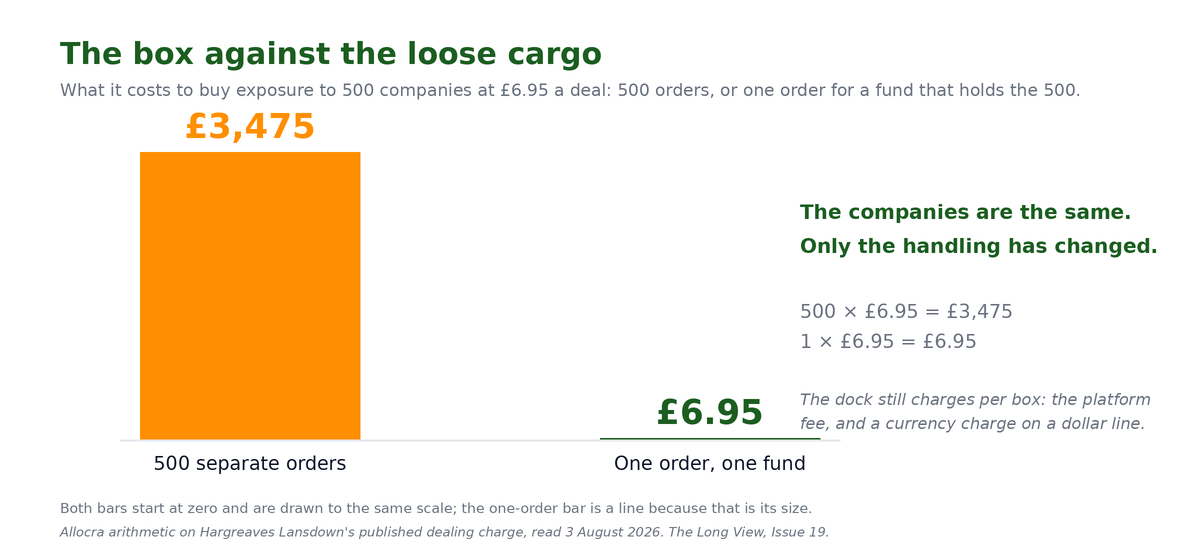
An index fund puts all 500 companies inside a single standard box. You place one order, the crane lifts it into your account, and it costs you £6.95.3 The companies inside are identical. Only the handling has changed.
The box made handling cheap. It did not make it free, and it did not change what was inside.
In investing, the dock still charges per box: a dealing charge on the order, a platform charge on the holding, and a currency charge if the box is priced in dollars rather than pounds. Standardisation solved the cost of delivery, not the risk of the cargo. And a box is only as good as its manifest: what is inside, and how much of it sits in the first ten lines, is the separate question Issues 16 to 18 discussed.
The standing theme this issue is friction: the cost of handling, as distinct from the cost of the thing. McLean’s sum was that handling was most of the cost and could be made almost none of it. The same sum, run on a portfolio, is the one the dealing charge and the currency charge answer.

Diary
- 28 October 2026 The Budget.
- 6 April 2027
- Unused pensions come inside inheritance tax.
- Savings income tax rates rise by two points.
- The £12,000 cash ISA limit for under-65s.
- The 22% charge on cash interest in stocks and shares and Innovative Finance ISAs, and the money market fund rule, come into force (SI 2026/1018).
- 8 June 2027 New fund disclosure rules become mandatory.
- 6 April 2028 The earliest age to draw a pension rises to 57.
- 6 April 2029 Salary sacrifice above £2,000 starts to attract national insurance.
- 5 April 2031 The inheritance tax threshold freeze ends.
Reply with your answer, or with anything you spotted this week that should have been here.
Where the figures come from
- Office for National Statistics, Consumer price inflation, UK: September 2026, published 21 October 2026: CPI 3.5% in the twelve months to September, 3.1% in August. ONS, Average weekly earnings in Great Britain: September 2026, total pay growth May to July 2026, 3.9%. The state pension rises by the highest of the two and 2.5% (the triple lock); full new state pension £241.30 a week in 2026/27.
- HM Treasury, the Chancellor’s letter to the Treasury Select Committee, 31 July 2026, setting the Budget date of Wednesday 28 October 2026.
- Hargreaves Lansdown, Charges, hl.co.uk/charges, read 3 August 2026: dealing £6.95 (£3.95 at twenty or more deals in the previous month; £11.95 before 1 March 2026); account charge 0.35% a year on exchange-listed holdings, capped at £12.50 a month; currency charge 0.99% on the first £10,000; regular investing free.
- InvestEngine, Trading 212 and Vanguard UK charges pages, read 24 June 2026 (Trading 212 cross-checked 1 October 2026): no per-deal charge on exchange-traded funds.
- iShares, holdings file for iShares Core S&P 500 UCITS ETF, holdings as at 20 October 2026, read 22 October: ten largest holdings 38.37% of the fund (Nvidia 7.88%, Apple 7.45%, Microsoft 5.94%, Amazon 3.88%, Alphabet A 3.00%, Alphabet C 2.40%, Broadcom 2.39%, Meta 2.30%, Tesla 1.58%, Eli Lilly 1.54%); against the file dated 24 September 2026, 38.7% (Issue 17).
- Marc Levinson, The Box: How the Shipping Container Made the World Smaller and the World Economy Bigger, 2006: the Ideal-X, Port Newark, 26 April 1956, 58 containers; $5.83 a ton against 15.8 cents.
Diary: Finance Act 2026; SI 2026/1018; FCA PS25/20. Nothing here is a recommendation.
The Long View is written by Allocra. If you hold funds outside an ISA or pension, Allocra works out figures like the one above, what each holding costs at the platform’s own tariff, the reporting status, the excess reportable income and the gains, for the funds you actually hold, from your own records. allocra.co