The Varnish
A painting named for a layer of dirt, the charge that appears on no statement, and the Bank’s decision.

This week
The Bank raises. The Bank of England raised Bank Rate to 4% on Thursday, up a quarter point from 3.75%, where it had stood since December 2025. The vote was eight to one, and the one wanted half a point. The Committee’s reason is energy: with the conflict in the Middle East in its ninth month, it now expects inflation, 3.5% in September, to reach around 5% by the middle of next year before it falls back. For savers, the rate on easy-access accounts follows within weeks; the tax on the interest changes in April, as last week’s issue set out.1
The statement you were sent. Your platform provides you with a statement. Once a year, in pounds, listing everything you paid. The platform’s own charges, the dealing, the currency conversion, and the charges the funds took inside their prices. The rule has stood since January 2018. Most people never read theirs, and some never notice it arrive. It is the one document that shows the layer this week’s long read is about.2

One number
2,414. The number of different exchange-traded funds listed on the London Stock Exchange at the end of September. A big supermarket, with everything from bread to batteries, carries tens of thousands of items, and a few dozen kinds of tinned tomato. London has 87 funds with “S&P 500” in the name and 102 with “MSCI World”, which is more ways to buy the same five hundred American companies than there are ways to buy a tin of plum tomatoes. Most of the aisle is different labels on the same tin.5
The question
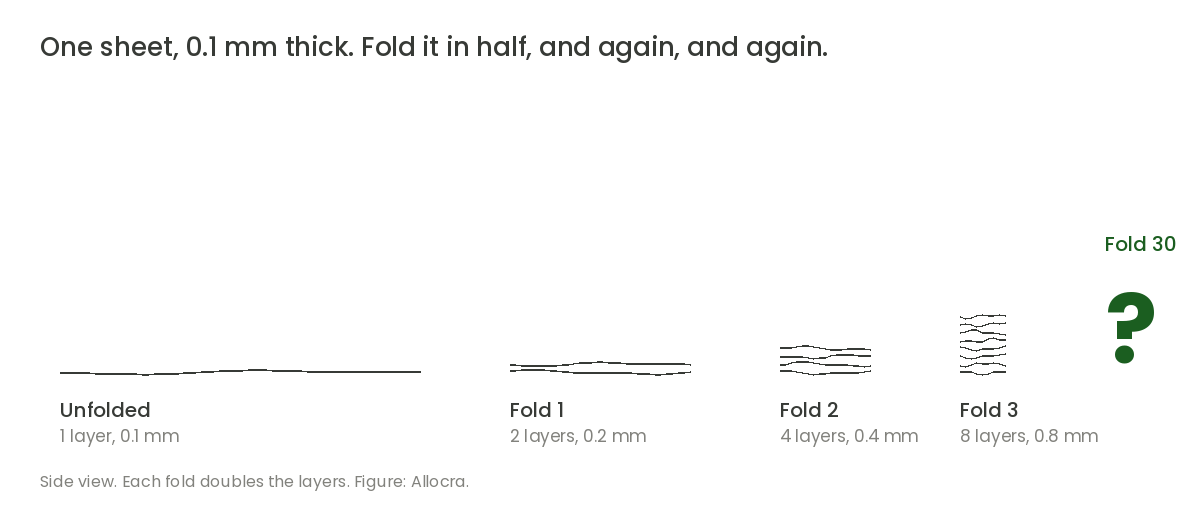
This week’s question. Take an ordinary sheet of paper, 0.1 mm thick, and fold it in half. Then fold it again, and keep going until you have folded it thirty times. How thick is the folded stack? Reply with your figure, or answer with one click below: Under 1 km, or Over 1 km. The working, and what it has to do with a portfolio, is next week’s long read.
Last week’s answer. £20,000 at 4% is £800 of interest. The first £500 is covered by the higher-rate personal savings allowance, leaving £300. At 40% that is £120 this year; at 44% from April 2027 it is £132. The difference is £12 a year, so Under £20 was the answer.4
The long read: The varnish
Regular readers might recall that I travelled to Paris at the end of October, for a cultural break whilst all the museums and galleries needed to close. If you are fortunate enough to walk through certain art galleries, you will notice that the seventeenth century appears to have taken place almost entirely in the dark. The old masters are famous for their moody, brooding shadows, where faces emerge dimly from a murky brown gloom. And possibly the most famous example in the Netherlands is Rembrandt’s The Night Watch.
Except there is a problem with that title. The painting is named after something that is not actually in it.
When Rembrandt finished the group portrait of Captain Frans Banninck Cocq’s militia company in 1642, it had no title at all. More importantly, it was not painted at night. It shows a company of guardsmen setting out in clear daylight. A drum, a dog, a girl in gold, and a musket shot being loaded, fired, and cleaned across the width of the canvas.
What the painting had was varnish. Varnish is the thin, clear layer painted over a finished picture to saturate the colours and protect the paint. It is meant to be invisible, and when it’s new, it is. Then it yellows. Then it browns. Each coat of varnish that a later century added to protect the picture darkened it a little more, until nobody alive had seen the canvas without one. By 1797, the name Night Watch appeared in a document for the first time. The militia had been marching in the dark for a century and a half, and the dark was a layer of protection that had become a layer of dirt.
The Rijksmuseum has treated the painting at least twenty-five times. In July 2019, it began the largest examination in the picture’s history, working inside a glass room in the gallery with the public watching. After five years of research, the conservators started removing the old varnish using cloths, solvents, and microscopes, clearing a few square centimetres a day. The museum’s own description of what’s underneath is plain. A daylight march, not a night watch. The name will remain, as names tend to do.
Once you understand what happened to Rembrandt’s canvas, you realise that a fund’s ongoing charge is the exact same thing. It’s financial varnish.
It is applied for a reason, it is thin, and you never see it as a separate layer because it is taken directly out of the fund's price before that price ever reaches you. No contract note shows it. No quarterly valuation itemises it. The fund’s price simply arrives on your screen each day a fraction lower than it would otherwise have been, and the performance picture you judge is the one with the varnish already on.
On a record we use as a worked example, £34,053 in two global tracker funds, that layer is 0.16% a year, which comes to £54.98 as at 10 October. The platforms holding the same record charge between nothing and £87.84 for their own fees, and those at least appear on a statement.3
Fortunately, there’s a cleaning, and it’s required by law. Since January 2018, every investment platform has been required to send every client, once a year, a single statement showing all costs and charges in pounds and pence, including the ones taken inside the funds.2
That annual document is the solvent. Most people haven’t opened it. Some haven’t noticed it arrive. A few platforms make it remarkably hard to find. It doesn’t tell you what to do with your money, and nor do we. What it does is tell you what the layer weighs, which is the one thing you cannot see just by looking at the picture.

Diary
- 5 November 2026 Bank Rate 4%, from 3.75%; the next decision is on 17 December.
- 6 April 2027
- Unused pensions come inside inheritance tax.
- Tax on savings interest rises to 24%, 44% and 49%.
- The cash ISA limit stays at £20,000; the 22% charge on cash interest in stocks and shares ISAs, in regulations already made, is expected to be revoked; confirmation awaited.
- A Pension Tax Allowance for pensioners with income up to the full new state pension, to April 2030.
- 8 June 2027 New fund disclosure rules become mandatory.
- Late 2027 Securities Transfer Tax replaces stamp duty on shares.
- 6 April 2028 The earliest age to draw a pension rises to 57.
- 6 April 2029 Salary sacrifice above £2,000 starts to attract national insurance.
- April 2030 The state pension triple lock is adjusted.
- 5 April 2031 The inheritance tax threshold freeze ends; income tax thresholds are frozen to the same date.
Reply with your figure, or with anything you spotted this week that should have been here.
Where the figures come from
- Bank of England, Monetary Policy Summary and minutes of the meeting ending 4 November 2026, published 5 November 2026: Bank Rate 4%, vote 8 to 1; CPI 3.5% in September, expected around 5% by mid 2027. Previous change: reduced to 3.75% at the meeting ending 17 December 2025.
- MiFID II, Article 24(4); Commission Delegated Regulation (EU) 2017/565, Article 50; FCA Handbook COBS 6.1ZA (annual ex-post costs and charges disclosure, in force 3 January 2018). Reference to be confirmed against the Handbook on Thursday.
- Allocra sample record (the worked example on allocra.co/professionals), prepared 15 October 2026, values at 10 October 2026: VWRP 0.14%, SWDA 0.2%, together 0.16%, £54.98 on £34,052.78; platform figures InvestEngine £0 (tariff 24 June 2026), Trading 212 £0 (1 October 2026), Vanguard £51.08 (24 June 2026), AJ Bell £62.00 (2 October 2026), Interactive Investor £87.84 (2 October 2026).
- gov.uk, Tax on savings interest, personal savings allowance 2026/27; HM Treasury, Budget 2026 Report, savings income rates from 6 April 2027.
- London Stock Exchange, Instrument List, edition 84, as at 30 September 2026: 2,414 distinct ETF ISINs (3,569 lines); 87 names containing S&P 500, 102 containing MSCI World; names counted by Allocra on 5 November 2026.
- Rijksmuseum, 10 things about Rembrandt’s Night Watch; Operation Night Watch (begun 8 July 2019); Why is the Night Watch so famous; How we are removing varnish from the Night Watch. All read 3 November 2026.
Diary: Finance Act 2026; SI 2026/1018; FCA PS25/20; Budget 2026 Report; Bank of England. Nothing here is a recommendation.
The Long View is written by Allocra. If you hold funds outside an ISA or pension, Allocra works out figures like the one above, what each holding costs at the platform’s own tariff, the reporting status, the excess reportable income and the gains, for the funds you actually hold, from your own records. allocra.co