The Highlight Reel
Why the loudest voices in your feed hold the worst records.
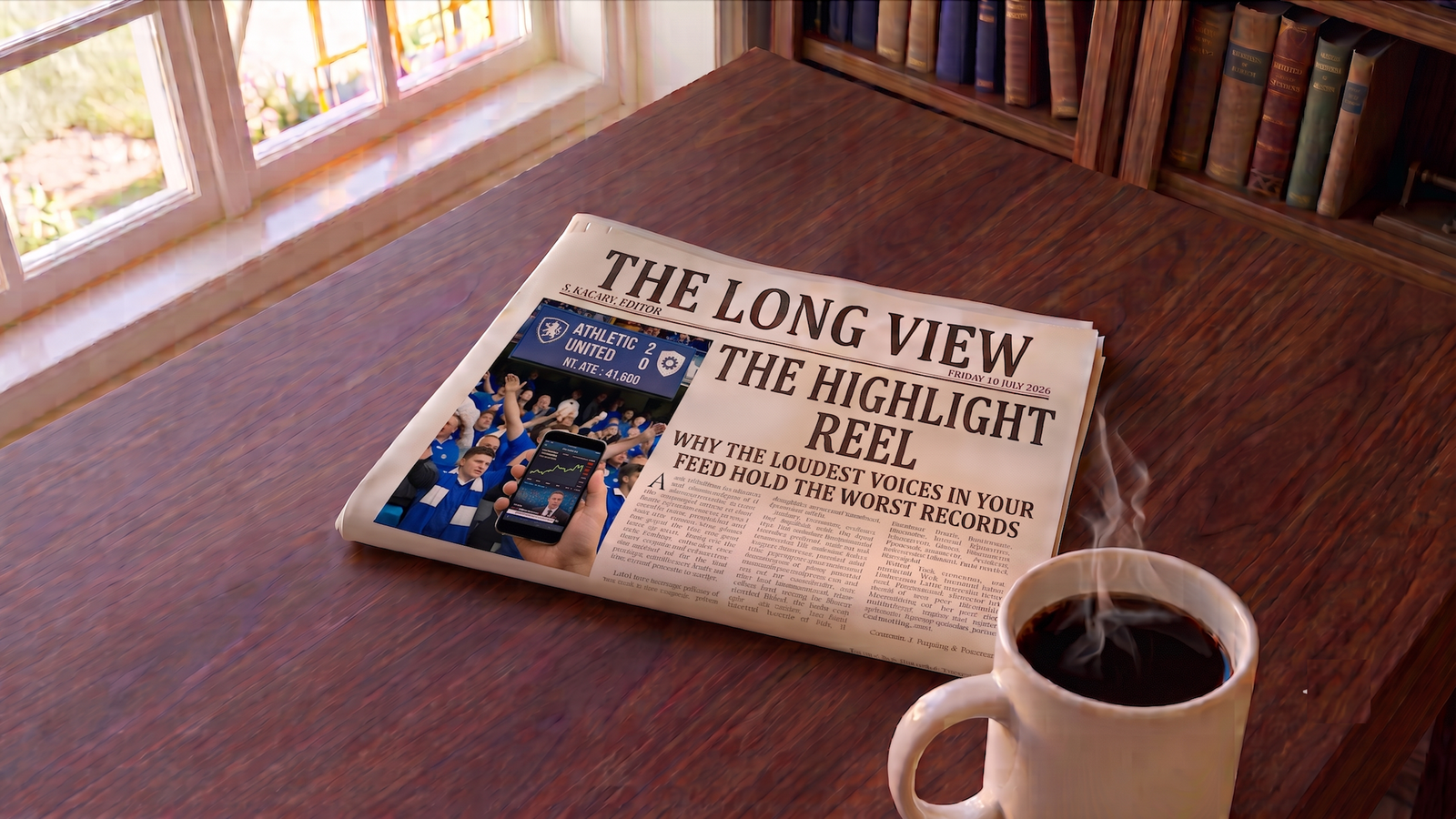

The Story
Daniel is 38. It is a Tuesday lunchtime and he is eating a meal deal at his desk, scrolling. The account he half-follows, the one with two hundred thousand followers, posted at seven this morning: three stocks positioned to run into earnings, conviction total, rocket emoji, 10x potential. The replies are full of people who got in early. Daniel holds one global index fund and, reading his phone, he feels like the only person in Britain not making a move. The FOMO is gnawing away at him, as he finishes his sandwich.
On Saturday he watched the football. Before kickoff the pundits did what pundits do, made predictions: final score, goal-scorers, no hedging. By quarter to five most of them were wrong, and everyone knew, because football keeps its score in public. Nobody unfollowed them. Nobody needed to. Being wrong on air is part of the pundit’s job, and it costs him nothing, because the predictions were never the product. They are the warm-up act, a bit of theatre to pull you into the match and the channel showing it. The pundit is paid to promote the game. His accountability is built in, and his livelihood never depended on the scoreline anyway.
Now ask the same question of the account Daniel read at lunch: what is the product? Not the three stocks. The product is the account. The followers are the revenue, and everything else follows from that arithmetic. The academy. The Discord community. The sponsored posts. Every post exists to grow and hold an audience, which means every post must project one thing above all: that this person wins.
Watch how the image is maintained, because the craft is real even if the returns are not. The winning call gets pinned, screenshotted, reposted on the anniversary. The losing calls are not deleted; they are simply never mentioned again, and the feed rolls forward. Catch the account in a drawdown and the register changes overnight: suddenly it is all long-term mindset, zoom out, nobody can time the market, keep dollar-cost averaging. The confident stock-picker of Monday and the patient coach of Thursday are the same account, holding the same losing position. You are watching a highlight reel narrate itself in real time. The full tape does not exist, because nobody keeps a public record of their own misses when the audience is the income.
A reader of our Sunday quiz put the mechanism precisely: a football score has a deadline, but a stock call can stay ‘not yet right’ forever. A prediction that cannot be marked wrong is not analysis. It is content, and it is working exactly as designed.
The numbers behind all this aren’t even close. One research firm tracked 6,582 public market forecasts from 68 well-known market voices across eight years: 47 percent correct, on what is mostly an up-or-down call. The coin does better. One BBC pundit, facing a harder three-way call 2,240 times over six seasons, scored 52 percent and beat the bookmakers at calling draws. And the study that explains Daniel’s feed: of 29,000 finance influencers examined on a stock-picking platform, 56 percent were anti-skilled, meaning that following their picks lost money at around 2.3 percent a month. That majority had more followers than the skilled minority. Read that again. The worse the record, the bigger the audience. Confidence travels faster than accuracy, and the feed’s ranking algorithm only measures speed.
This is the machinery that filled Sarah’s Sunday evening in Issue 3. The substack calling the top, the friend going to cash, the chorus saying de-risk: each voice upstream of her kitchen table had its own motivation, and not one of those motivations was Sarah’s portfolio. Half of navigating noise is knowing what it costs you. The other half is knowing why it is being made.
Daniel closes the app and thinks, briefly, about the fund he owns. It has never posted anything. It has no follower count to feed and nothing to sell him. It also has a public price, marked every trading day for a decade, dividends recorded, costs disclosed to the fourth decimal. The most boring thing Daniel owns is the only voice in his pocket with a dated, public, marked-to-market record. It has just never needed to talk over anyone.

Hype Watch · The Mid-Year Reforecast
July is outlook season. Across the financial press and the bigger investing accounts this fortnight, January’s year-ahead index targets are being reissued at half time: levels revised, conviction refreshed, six months of hindsight quietly repriced as foresight. The motivation is the same as January’s: outlooks are marketing documents that generate coverage, meetings and flows.
The January edition has a published record. Analyses of Wall Street year-end targets find strategists underestimated the S&P 500’s year-end level in 13 of the past 16 years, with an average miss of roughly 10 percent. A mid-year revision of a forecast with that history is not a second opinion. It is a second serving.

The Closer
The ETF X-Ray and the True Cost calculator are free, covering the nine most-held UK retail ETFs.
The Allocra beta opens Monday 20 July, with two of five separate tools at launch: the ETF Screener and the ETF Optimiser, both running on live data refreshed weekly. Joining the beta list carries no commitment. The first 250 subscribers lock Founders pricing, £9 a month or £79 a year, for as long as their subscription stays continuous.
Allocra is being built as an investor companion, which is the opposite of an account with a position. No picks. No conviction to perform. No follower count to feed. Just your portfolio, the data behind it, and the same engine that re-reads our whole ETF universe every Saturday, learning over the months ahead to watch yours between your decisions.
No tool will ever tell you what to do.
That part is yours.
Run the X-Ray →Forward this issue to one independent investor whose feed is louder than their portfolio.
The Long View is general educational content for UK and US independent investors. It is not investment, tax, financial, or any other form of regulated advice. Allocra Ltd is not authorised or regulated by the Financial Conduct Authority. Past performance is not a guide to future returns.
Issue 4 of The Long View. Published 10 July 2026. Previous: Issue 3, The Morning After. Forward this issue to one independent investor friend.
allocra
Cut the noise. Cut the fees.