Ronaldo, Bart Simpson & Napoleon Walk into a Bar
They have plenty to talk about.
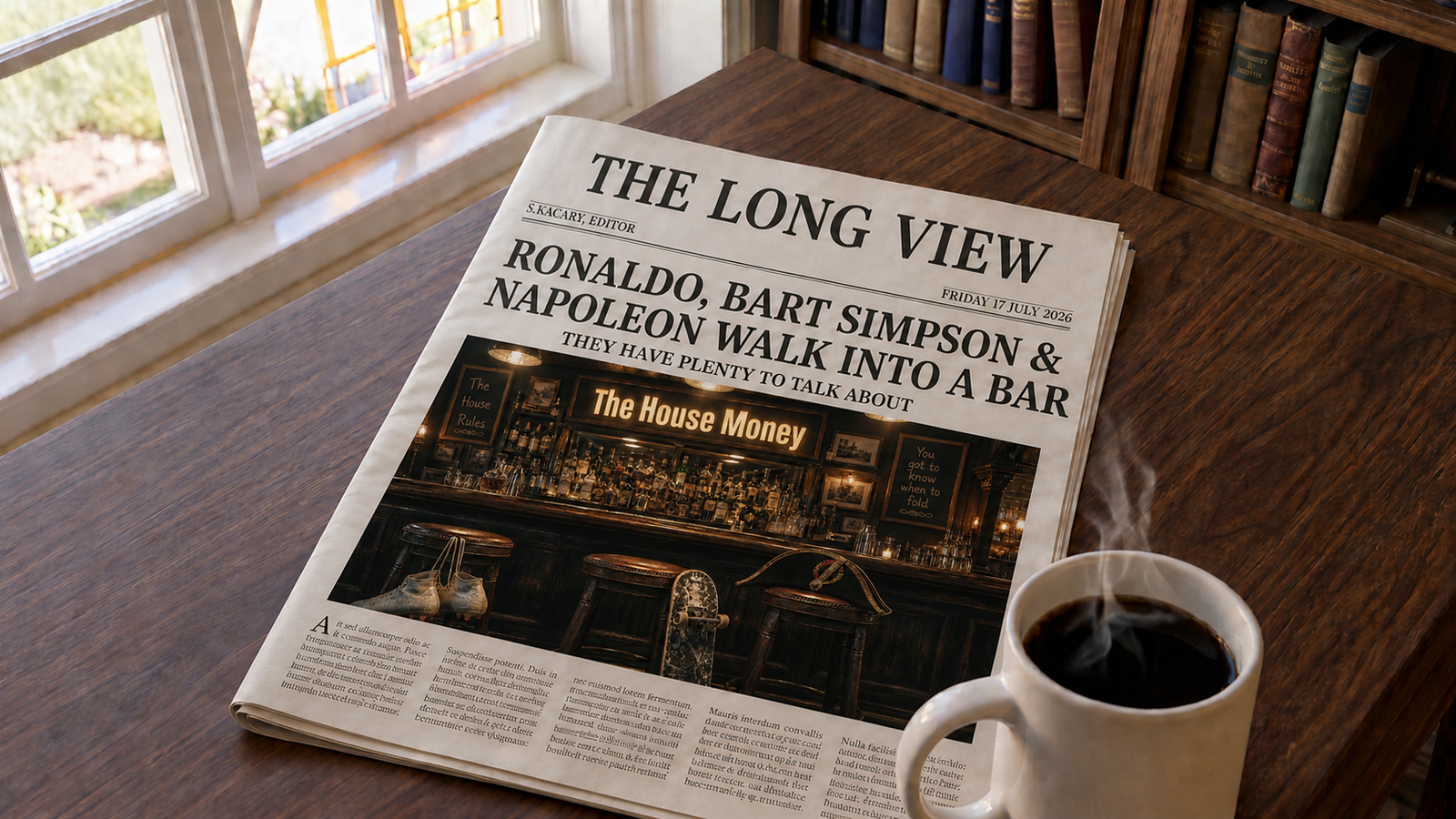

The Story
Cristiano Ronaldo is 41. This summer he played at his sixth World Cup. A record only matched, at the same tournament, by Messi. Two hundred and thirty-three caps. A hundred and forty-six international goals. Nobody has more of either. And somewhere in every match of the tournament, between flashes of the player he was, sits a question the commentators keep asking. Not whether he was great. That is settled. Whether his past acts as a constraint on the squad’s collective output.
The Simpsons is in its thirty-seventh season. Its first nine were critically acclaimed as a masterpiece of social satire and cultural influence. The seasons have continued to run indefinitely, driven by attractive revenue streams. From season eleven onwards, critics noted a severe decline in writing quality and characters. It had entered what even its most ardent fans call the ‘Zombie Simpsons’ era. Still walking, still recognisable, a long way past the years that mattered. The show that taught television how to land an ending has spent two decades unable to find its own.
In June 1812, Napoleon crossed the river Neman with the largest army Europe had ever assembled; more than half a million men. By the middle of September he had Moscow. It was the summit of the greatest winning streak in modern military history, and it was already finished. The retreat began five weeks later, and only a fraction of that army came home. A Prussian officer who survived the campaign, Carl von Clausewitz, spent the rest of his life turning it into theory, and gave the pattern a name that belongs on an investment statement: the “culminating point of victory”. The moment when an attacking force’s advance becomes politically or strategically counterproductive, leading to defeat.
A striker, a cartoon, an emperor. The pattern is identical, and it has nothing to do with football, television or war. Nothing announces its peak. Peaks are only visible in the rear view mirror. And the person holding the winning position is always the last to see one, because the moment a peak forms it stops being a price and becomes a reference point.
Which brings us to you.
Imagine a few years ago buying a fund, a good one, chosen for sound reasons, and it did what good funds occasionally do; it ran. At its high last autumn, it stood more than eighty percent above what you paid. It has since dropped twelve percent from that high, which leaves you sitting on a gain you’d have secretly hoped for on purchase. That is not what you see. Your statement shows the high. Your memory shows the high. Somewhere in the past year, without a single decision on your part, a price that existed for about eleven days stopped being a number and became the truth, and everything below it became a loss.
Behavioural finance has spent forty years mapping what happens next, and it happens to nearly everyone. On the way up, the gains never quite felt like your money. Researchers call this the ‘house money’ effect, after the casino gambler who plays loose with winnings, and it is part of why the position was allowed to grow so large, so comfortably, for so long. The fall reversed the trick in a single statement. The moment the fund dropped from its peak, the gains stopped being the market’s money and became yours, and every pound of the retreat became a small theft to be reversed. You are not managing an investment any more. You are waiting to be made whole. And what is now your plan? It will be the exact plan made at every peak in market history: sell when it gets back.
The arithmetic of getting back is crueller than it looks. Give back a quarter of a position and you need a rise of a third to return. Give back a third and you need a half. Give back half and you need a double. The escalator down runs faster than the escalator up, which makes waiting to be made whole one of the most expensive popular strategies in investing, and one of the least discussed.
There is a reason this pattern survives longer inside a portfolio than anywhere else. Portugal kept winning matches, so the question about the aging talisman figure was never properly addressed. The Simpsons franchise still generates revenue, so the question about the writing never reaches the board. A winning aggregate protects its weakest component. Your portfolio does exactly the same thing. The number you actually check is the total, and while the total is rising, few afford the time to audit the parts. A fund years past its culminating point can hide for a decade inside a headline number that keeps going up, subsidised by the holdings around it, the way a fading striker is subsidised by the midfield that runs that little bit more and looks to pass to him before anyone. The overall number is the most watched figure in retail investing and the least informative, because it’s the one place a fading peak goes unnoticed.
Here is what this publication will not do: pretend anyone can call a peak. Nobody can. Not us, not you, and not the professionals. Portugal’s management team, the Simpsons writers room and the staff officers of the Grande Armee all had more information than any private investor will ever have, and every one of them marched past the point. The people who escape the pattern do not share foresight. They share rules, written down before the emotion arrived. A decision, made in advance, about what happens when a winner doubles its share of the portfolio or falls a fixed distance from its high. A ceiling on how large any single position is allowed to become. One standing question, would I buy this today at this price, asked on a schedule rather than in a panic.
And all such rules share a single dependency: someone has to be watching, on the schedule, against the rule. The person anchored to the peak is the least reliable watchman of their own anchor.
The oldest solution to that problem is the one Ulysses used: decide while you are calm, then bind yourself to the decision before the singing starts. The modern version is plainer. Write the thresholds down while nothing is at stake, and arrange for the facts to be delivered back to you when one is crossed. Not a forecast, not advice, not somebody else’s opinion about the peak. Your own rule, quoted back to you by something that has no memory of what you paid and no feelings about the high. The rule is written by the calm version of you. The alert does not care about the peak. That is the entire point of it.

Hype Watch · The Consensus Arrives
This week Bloomberg Opinion declared that leveraged single stock ETFs will, in time, maul the retail investors who love them, and described that conclusion as close to consensus. Our Hype Watch reached it a month earlier, in public, with a date on it. We note the sequence not as a lap of honour but because of what these products are: machines for holding the most concentrated possible position at the most excited possible moment, with the dials turned to maximum and a reset every day. Everything in today’s story, at ten times the speed. When the loudest products and the oldest bias point the same way, the direction is rarely good.

The Closer
The ETF X-Ray and the True Cost calculator are free, covering the nine most-held UK retail ETFs.
The Allocra beta opens Monday. Two of five tools at launch: the ETF Screener and the ETF Optimiser, both running on live data refreshed weekly. Joining the beta list carries no commitment. The first 250 subscribers lock Founders pricing, £9 a month or £79 a year, for as long as their subscription stays continuous.
One more thing, because it belongs to this story. The Optimiser already saves every portfolio it builds, and every Saturday morning our engine re-reads the whole ETF universe. Where this goes is a portfolio that is watched between your decisions: drift, cost, income and concentration checked against rules you set while you were calm, surfaced with data, never with advice. A watchman with no memory of the peak, no feelings about it, and no rulebook except yours.
No tool will ever tell you what to do.
That part is yours.
Run the X-Ray →Forward this issue to one investor who is waiting to be made whole.
The Long View is general educational content for UK and US independent investors. It is not investment, tax, financial, or any other form of regulated advice. Allocra Ltd is not authorised or regulated by the Financial Conduct Authority. Past performance is not a guide to future returns.
Issue 5 of The Long View. Published 17 July 2026. Previous: Issue 4, The Highlight Reel. Forward this issue to one independent investor friend.
allocra
Cut the noise. Cut the fees.