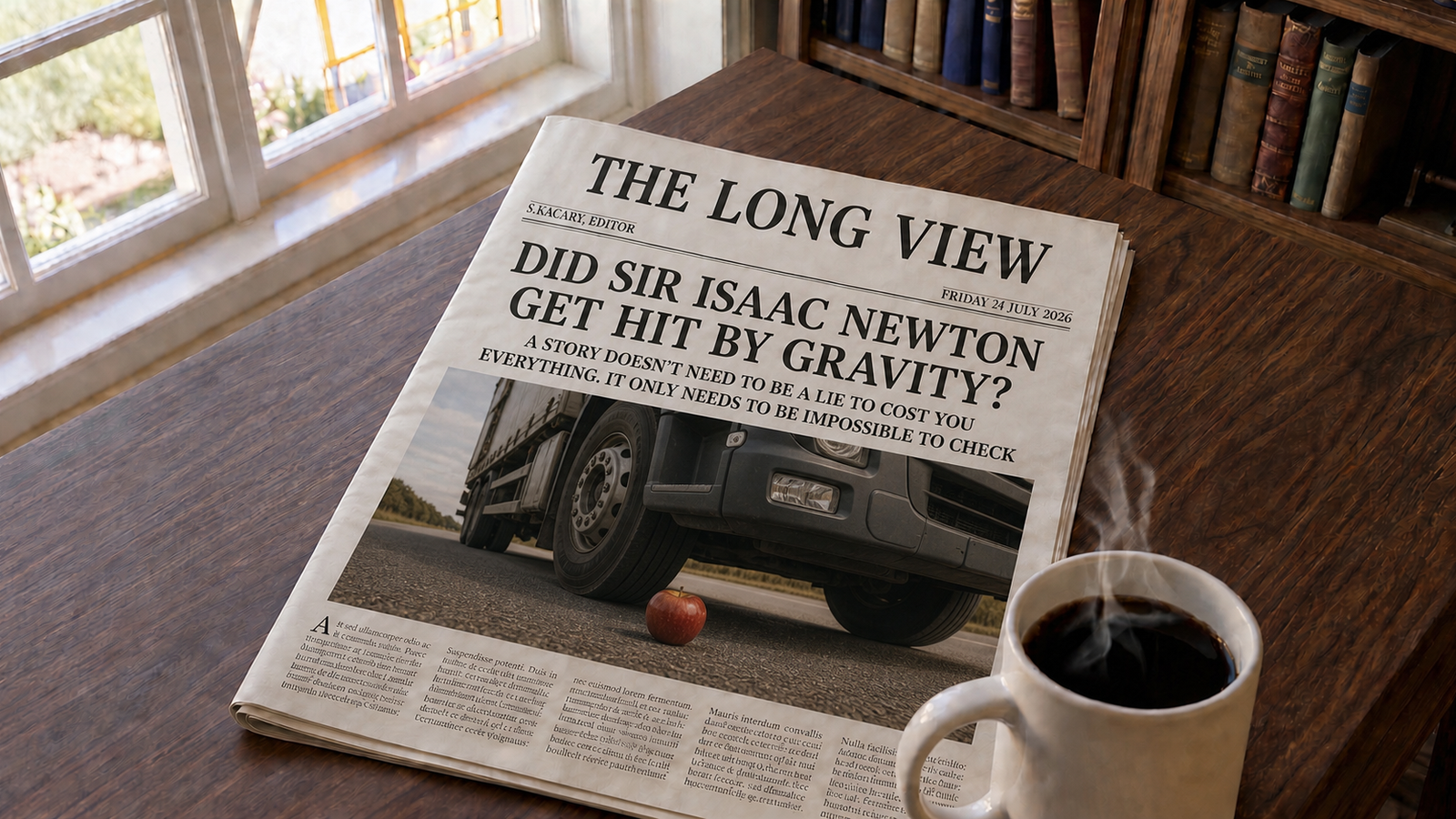
Did Sir Isaac Newton Get Hit by Gravity?
A story doesn’t need to be a lie to cost you everything. It only needs to be impossible to check.

The Story
Isaac Newton discovered the laws of motion and universal gravitation, usually simplified to: what goes up must come down. If legend is to be believed, something heavier than an apple proved the theory in 1720.
The most exciting company in England that year was the South Sea Company. It had a real business, managing government debt for a fee, investors earning a steady interest. To increase enthusiasm in their shares, the company held a real, if limited, trade monopoly with Spain’s South American colonies. The shares were further pumped on the myth of El Dorado; tavern talk of limitless gold. Newton bought shares and doubled his money. He sold, congratulated himself, and then watched from the side as the price kept climbing without him. So the man who could calculate the motion of every planet bought back in, near the top, with most of his fortune. By the autumn the shares had collapsed and Newton had lost the equivalent of millions. He reportedly could not bear to hear the words South Sea for the rest of his life. What hit him wasn’t gravity. It was a structure that is still standing, and it has three floors.
To see the floors clearly, imagine a company that does not exist. Bark & Byte is a premium organic dog food delivery service. The dog food is real, the market is competitive, and the valuation is ordinary. That is the first floor: a business you can check against its revenue.
Their marketing materials promise a smart collar, under development, that reads a dog’s biometrics and can text its owner, “I think I’m catching a fever”, “I need more exercise” or “My heart is under unusual strain”. The collar doesn’t exist yet, but it might, and the valuation climbs above dog food. That is the second floor: a promise you can check against a delivery date.
And on the third floor, Bark & Byte has a dedicated team working on interspecies consciousness uploading: the collar’s AI will one day map a deceased pet’s mind into a Canine Metaverse, where owners pay a subscription for premium digital real estate their dog can enjoy after death. You cannot check the third floor against anything, because it lives permanently in the future. That is precisely the point. A promise that can never be marked wrong can hold any valuation you like. The building has a magnificent roof and no stairs.
Whenever a company misses on the first floor and its price goes UP, you are watching the story move upstairs. The South Sea Company’s trade never grew; the story simply climbed from debt fees to trade monopolies to a continent of gold. And it still works today. In 2020, a truck maker with barely any revenue was briefly worth more than Ford: trucks on the first floor, hydrogen engines on the second, and on the third a private nationwide network of hydrogen fuel so cheap it would be given away free. The most famous evidence for all this was a film of a prototype truck cruising down a road, powered by something the company chose not to mention: gravity. It had been rolled down a hill. There is nothing more creative than a lie, and this one had a film crew. A court later convicted the founder of fraud. The building came down through its floors in the usual order. Third first.
Which brings us to you, and to the honest part. Sometimes the story comes true. The online bookshop really did become everything, and every buyer of every third floor knows that example by heart, which is exactly why the trick keeps working. The lesson of Newton is not that stories are lies. It is that you cannot tell, in advance, which kind you are holding, and neither could the finest mathematical mind of his age. So the useful questions are not about vision. They are about weight. How much of your future is standing on the third floor? What would this company be worth if the building were only as tall as its revenue? An index, dull as it sounds, owns the occasional miracle without betting the house on any single one. Newton could not calculate the madness of crowds. You do not have to. You only have to decide how much of your money lives upstairs.

Hype Watch · Private Markets Come to Retail
The loudest product pitch of the year is that ordinary investors are finally being allowed into private equity and private credit, the way in through funds, platforms and pension menus. Notice what the pitch celebrates: assets that do not trade, priced by the people who manage them, wrapped in fees that would embarrass a hedge fund, sold as calmer because the price never appears to fall. An asset that never shows you a falling price is not calmer. It is quieter. Volatility you cannot see is still volatility; you simply meet it all at once, at the exit, when someone finally has to name a number. When the third floor of the market is being marketed to the ground floor, the direction of the wealth transfer is rarely in doubt.

The Closer
The beta opened on Monday. It is small, it is early, and it has already made the tools more honest. The ETF X-Ray and True Cost calculator remain free.
The first 250 subscribers lock Founders pricing, £9 a month or £79 a year, for as long as their subscription stays continuous.
One more thing, because it belongs to this story. This week the Optimiser started showing its workings: every fund in an optimised portfolio now explains why the engine chose it, score by score, with the method published. The wire our engine reads every Saturday carries numbers, not narratives. A concentration alert does not know what the story is. It only knows how much of your future depends on the story being true.
No tool will ever tell you which stories come true.
That part is yours.
Run the X-Ray →Forward this issue to one investor who is up three floors.
The Long View is general educational content for UK and US independent investors. It is not investment, tax, financial, or any other form of regulated advice. Allocra Ltd is not authorised or regulated by the Financial Conduct Authority. Past performance is not a guide to future returns.
Issue 6 of The Long View. Published 24 July 2026. Previous: Issue 5, Ronaldo, Bart Simpson & Napoleon Walk into a Bar. Forward this issue to one independent investor friend.
allocra
Cut the noise. Cut the fees.